A footballer's life
Ever wondered what an AFL footballer goes through from the moment the final siren sounds to when they next run through the banner?
When Brad Ebert and Andrew Gaff shook hands on Adelaide Oval following West Coast's win over Port Adelaide in Round 7, both knew what was in store for the other.
The result, a loss for Ebert and a win for Gaff, affected their respective moods but did not change the task at hand. The next 72 hours was all about recovering for the next week. It's a process the duo know better than most.
Since the start of 2012 both men have missed just one game. Gaff has played 135 matches out of a possible 136, breaking the club's consecutive games record last year before his streak ended at 113. He missed one game with a severe concussion but has played every one since.
Ebert has played 123 out of 124 since being traded from the Eagles to Port Adelaide at the end of 2011. He had played 106 in a row before missing one week late last season after suffering a bruised lung.
North Melbourne's Sam Gibson (117), Melbourne's Nathan Jones (106) and Geelong's Zac Tuohy (100) are the only players with active 100-plus streaks.
In VFL/AFL history, there have been only 119 instances of players running out for 100 consecutive games or more, with legendary Demon Jim Stynes holding the record at 244 in a row.
In such a brutal combative sport, what does it take to get up to play week after week after week?
The recovery phase
Immediately following the Port Adelaide vs. West Coast clash, both sides went straight into a team meeting with coaching staff (the Eagles were delayed slightly by the singing of the club song). This happens after every game regardless of the result.
Then the players switch into recovery mode. It's like an automated switch for Ebert and Gaff. First, it's food, hydration and ice baths. Players can lose anywhere between 1-3kg during a game and getting food and liquid into their bodies post-match is vital. For some it's easier than others.
"The last thing I feel like is eating after a game," Gaff told ESPN.
"I'm absolutely exhausted and don't have the energy or stomach to eat, whereas some guys can eat a full burrito after the game."
Ebert said it's chicken burgers or pizzas in the Port rooms. He said a lot of his teammates were like Gaff but he had no issues eating post-match.
"I'm not too bad actually," Ebert told ESPN.
"Usually after a game I'm quite OK eating a chicken burger. After a game I'll try and eat the majority of that while I'm sitting in the ice baths even. Usually I can stomach that most games."
There's some stretching. Some players with specific corks, knocks or strains will have ice strapped to the trouble areas. The medical staff check over most players. Some, like Ebert, move reasonably freely post-match. Others walk around very gingerly. Gaff is one of those.
For the home side, it's a swift exit. Ebert said he was home relaxing on the couch about two hours post-match. This game finished at 7pm and he was home a little after 9pm.
For Gaff and West Coast, it's a different story.
"Once we've done the ice baths, we have a shower and normally we have post-match functions afterwards," Gaff said.
"We're hanging around at the ground for an hour and half after the game. We go to the airport from there.
"I think that Port Adelaide game we started at about 4pm Adelaide time and we didn't get back until about 12.30am Perth time, which is really about 2am Adelaide time. The days are very long and I think it does hinder some part of your recovery."
The flight can be uncomfortable. Despite the fact older players and bigger bodies are in business class and the remainder are in premium economy, three hours in a plane after a game is not ideal. Adelaide to Perth is the shortest flight home for the WA teams. Gold Coast or Hobart trips can be six or seven-hour commutes.
“Depending on if you've got a knock or a niggle, you'd be icing throughout the flight.”
- ANDREW GAFF, West Coast
"Otherwise it's expected you're getting up two or three times on the way back and moving around which just helps the blood flow in the plane. we as a footy club have got to be a bit more advanced in that regard. I don't wear compression tights. Some boys do."
The temptation is to sleep on the plane but Gaff is wary of driving home from the airport due to not moving well after the flight.
Provided the flight is on time -- as it was after the Port Adelaide game - Gaff is home by 1.30am (Perth time), or 3am (Adelaide time).
Ebert, though, is tucked up in bed at that stage but he's rarely comfortable. A lot of players have trouble sleeping post-match, particularly after night games. This was a twilight fixture but it doesn't make a difference. Both Ebert and Gaff said they would happily take five hours' sleep if they could but often it's closer to three. For Ebert, adrenaline or a cork of some description can keep him awake. For Gaff, his high body temperature and his mind replaying the game are often the contributing factors.
Some players will wake up at regular intervals during the night to ice a specific injury that might be more serious than a knock. Neither Gaff or Ebert believe in the practice - both will ice pre-bed and first thing in the morning if necessary but won't set alarms every two hours.
(Photo by Matt King/Getty Images)
Sunday is a late start for a swim and stretch at the beach but both men said they can never sleep in, even if they tried. The Port players are left to do recovery on their own time. Ebert heads to Henley Beach with his dog for a swim and a stretch. Gaff will join his teammates at City Beach or at the club's facility at Domain Stadium if the weather is bad.
Ebert said he usually pulled up OK on Sundays but Monday was a different story.
"You're still pretty fatigued and pretty tired," Ebert said. "I actually find the day after, two days after the game, I'm probably the worst. I wake up OK the day after the game."
Gaff felt the same.
"I find two days after a game I almost feel more sore than I do the day after the game," he said.
"Scientifically I'm not too sure how that happens but I think it is pretty common amongst a lot of boys in our team."
Both clubs train on the Monday. The sessions are designed specifically to get the body moving again.
"Our Mondays are really recovery-based," Ebert said.
"We'll do a light gym session where it's just bodyweight squats and very light dumbbell presses just to get your body moving again. We do a mobility circuit where the boys go through a half-hour doing different light exercises which is based around getting your body going again. That includes two laps of walk/jogs and then more recovery as well and that's fitted around meetings."
The Eagles are similar, with a light skills session available if they feel up to it.
Monday will also usually involve a massage and more medical checks. But by Tuesday both said they are feeling somewhere close to normal again.
He's gone for a scan
Fremantle coach Ross Lyon often jokes that players get scanned for a cold these days. And while the media often reports players going for a scan as big news, Gaff and Ebert said it's normal, but not as frequent as one might think.
"Probably twice (a season)," Gaff estimated.
"Sometimes you might get a scan early in the year for, let's say an ankle, and for the next few weeks the ankle is stiff and sore but you still know what the diagnosis of that scan was. I reckon twice [a year]. Sometimes more, sometimes less."
Ebert concurred although he said when he had a specific injury late last year that required post-season surgery, he was getting it regularly scanned for the surgeon's benefit.
Missing the main session
The Eagles held their main session on the Tuesday of this particular week due to a six-day turnaround. They faced the Western Bulldogs on the Friday night at home and always hold the main session three days out.
Players can often miss a main session due to an injury concern and still play on the weekend. How that affects them both mentally and physically depends on the individual.
Gaff said a large part of recovery for him was making sure he could get to the main session.
"I think the main purpose of recovery and stretching is to make sure you're not just ready for the weekend's game but you're ready to train that coming week," Gaff said.
"Because it just gives you the best chance of playing well. If you're not able train during the week you run the risk. I've done it a quite a few times where you're pretty stiff and sore and you don't train during the week, and the first few minutes of the next game you're prone to fumbling and dropping marks, so it's important to get up for training as much as you can."
Ebert, three years older and with 58 games more experience than Gaff, said he was unperturbed if he missed the main session.
"I'm OK with it," Ebert said.
"It depends on the severity of the injury that you're trying to deal with. If it means I'll have to do a pool mobility session or a bike session instead of a session on the track I'm OK with that. I think boys can get a little bit caught up on how they're training during the week and whether that's going to affect them."
Ebert said he did play with a fractured hand one season that made training and playing weekly a tough exercise.
To nap or not to nap
There's myriad theories about the best recovery methods but both players agreed sleep was a critical element. Sleep experts will tell you that regular sleeping patterns and seven to nine hours of quality sleep is optimal for healthy adults.
Gaff said sleep was a key component of his recovery and he also added an hour-long daytime nap one-to-two times a week to catch up on the sleep he lost post-match.
"I find it important and probably it mentally helps me and puts me in a good space for the rest of the week," Gaff said.
"A lot of boys with kids probably don't have that luxury."
Ebert falls into that category, having become a father for the first time in the lead up to the West Coast clash. Ebert said he wasn't a napper, although many of his teammates are. He did say sleep was important but not vital to function.
"We just had Leo (Ebert's new-born son) a couple of weeks ago and I'm starting to figure that one out," Ebert said.
"A lot of the time you're not needing to have a lot of sleep, it's just making sure that you're getting enough of it to feel okay."
“The last couple of weeks I've realised that you can still happily function on five hours [sleep] whereas if you'd asked me that six months ago I'd be saying 'no way'.”
- BRAD EBERT, Port Adelaide
Ebert likes to do other modes of recovery during the week. He often does pilates or yoga depending on how he feels. He has also turned to meditation, as many modern players have.
"I've really been finding that quite beneficial over the last year or so, just to chill out and try and find some of my own time and a bit of space really," Ebert said.
Gaff doesn't do anything special other than stretch every night at home to try and improve his relative inflexibility.
Other players use different methods. Two-time Coleman medallist Josh Kennedy floats in Epsom salts in a sensory deprivation tank. Former Fremantle champion Matthew Pavlich used to do a form of hybrid yoga later in his career. Pavlich played 160 matches in a row at one point during his 353-game career.
Can I get through?
Despite Gaff and Ebert's incredible durability, both have had doubts late in weeks as to whether they will be able to play.
All teams have a 'captain's run' the day before the game and both men have got to that training session in doubt.
"I've rocked up to a few sessions the day before a game and not been sure whether I would be able to get up," Gaff said.
"There's also been times during the warm-up before the game, literally half an hour before the game, where I've got pretty tight in certain areas and wondered whether I could play a full game, which is not ideal. You need the feedback from the physios. I've been lucky enough to play in those games and get through and play reasonably well."
Gaff's teammate Sam Butler was withdrawn from a contest last year minutes before the bounce after suffering an injury in the warm-up. There are many stories of players suffering quite significant soft tissue injuries in captain's runs and or warm-ups and still playing.
Ebert said he would never leave it past the captain's run to make a decision but he has been concerned during that session on a number of occasions.
Survival of the fittest or luck of the draw?
Both Gaff and Ebert attributed their durability to a fair bit of good fortune.
"I'm very fortunate and grateful where I've had some years where I've been able to play every game," Gaff said. "Because you see guys fall over through no fault of their own and do their ACLs and miss 12 months. So I'm very fortunate."
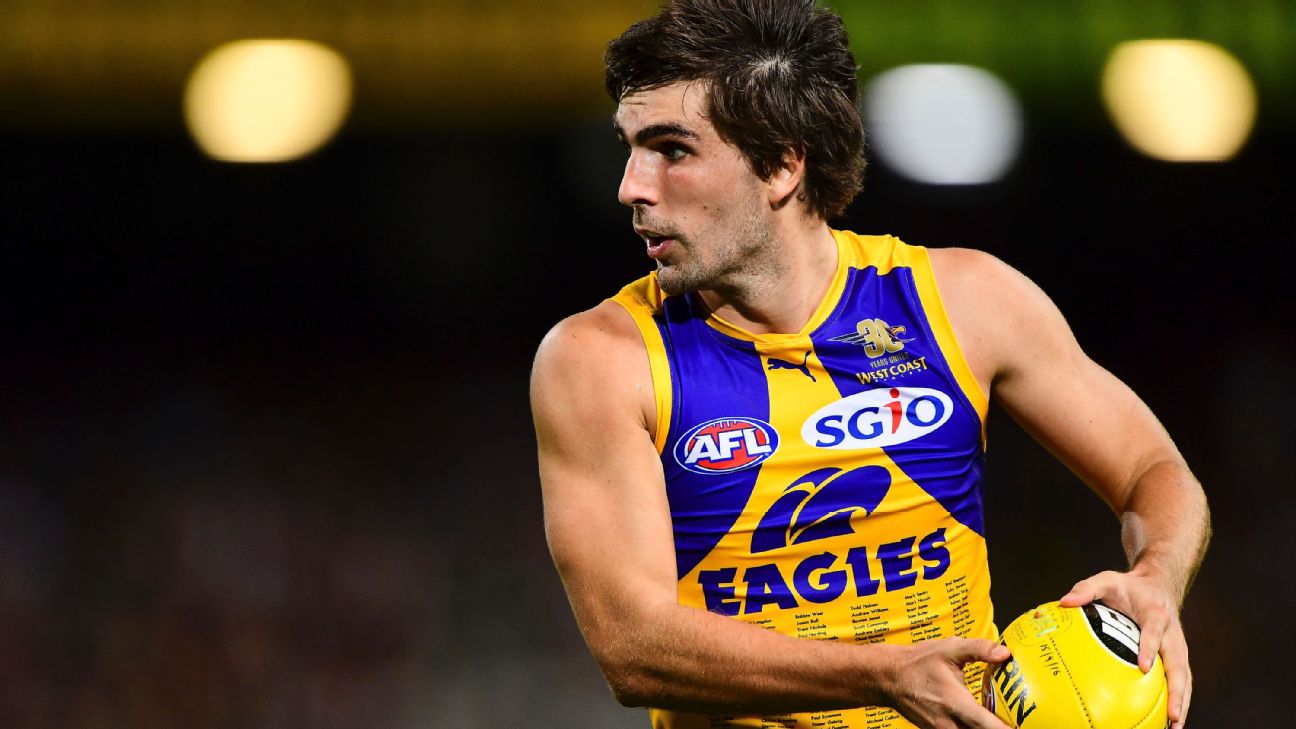
Photo by Daniel Carson/AFL Media/Getty Images
Ebert felt equally lucky.
"The majority of the boys each year are doing stuff very similar to me," Ebert said. "I wouldn't say that I'm doing anything above and beyond the majority of the boys to be honest with you."
Both agreed that the toughest point of the year to back up week after week was the last month-and-a-half before finals.
"Probably that five or six weeks before the end of the season," Ebert said. "It's right in the middle of winter and your body is really starting to fatigue. That's probably the hardest period."
Gaff called the last six weeks of the season a "survival of the fittest for individuals and teams."
The cycle continues
Gaff recovered from a six-day turnaround following the Port Adelaide game to have 35 disposals and kick a goal in the Eagles' narrow win over the Western Bulldogs on the Friday night. He polled six votes in the AFL Coaches Association MVP award, second-best for the night behind skipper Shannon Hurn.
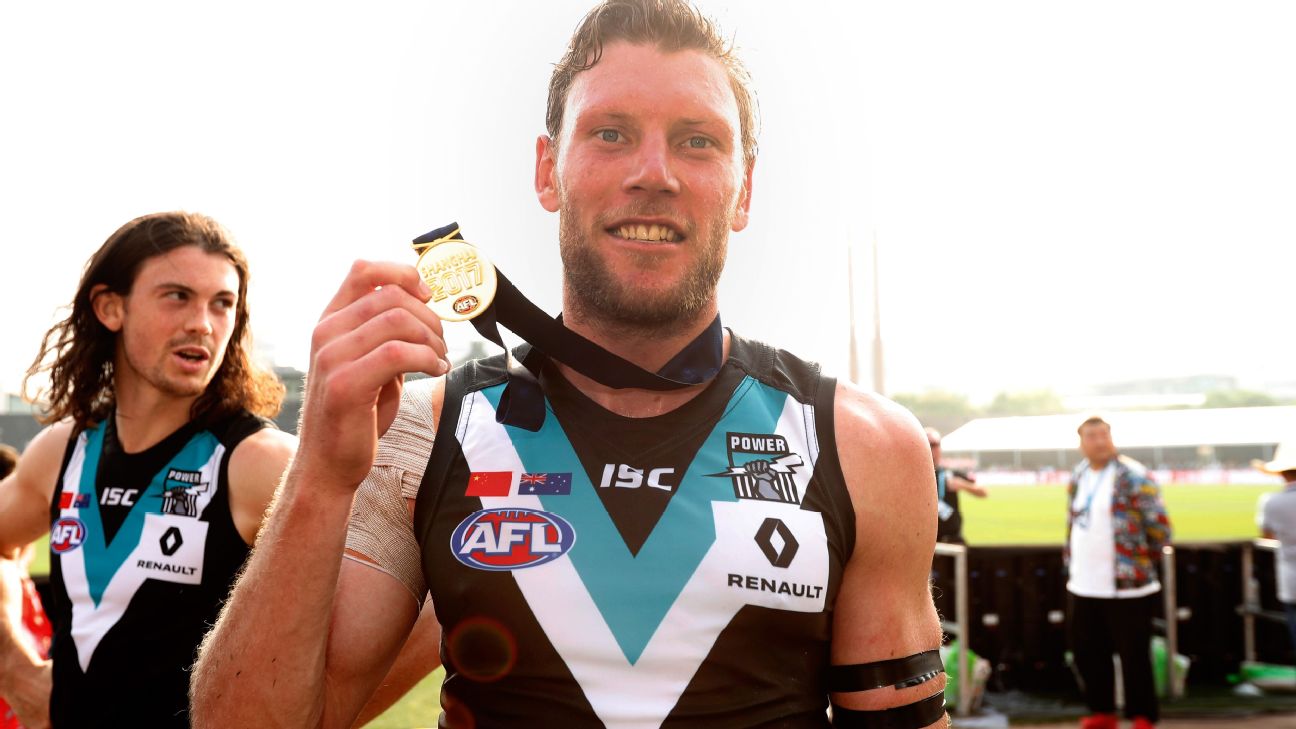
While Gaff was playing in Perth, Ebert was in Shanghai, China, for Port's landmark match against Gold Coast. Most of the Port team flew to China on Tuesday night but Ebert did not leave until Thursday night to maximise time with his wife and new son. It was a 15-hour commute. The first leg to Hong Kong was overnight and Ebert slept.
"I landed Friday morning quite fresh really and was OK. Great result really," Ebert said.
He made sure he was moving every hour during the second leg to Shanghai. He touched down Friday afternoon and walked around Shanghai with some teammates.
The Port players had a captain's run on Saturday and Ebert said he did some extra pool recovery and meditation at the hotel Saturday afternoon due to his later arrival.
He was best on ground on the Sunday, gathering 31 disposals and the newly minted Shanghai medal in Port's thumping 72-point win.
Port and Gold Coast had a designated bye after the Shanghai game with the recovery an unknown for both teams. Port arrived home on Tuesday but Ebert said he could have got up for another game the following Sunday.
"The bye is very handy but I definitely could've played again," Ebert said.
"The way the club managed it, they were outstanding. But if there was another game on the Sunday, a seven-day break I'd say I would've been fine."