NEXT DYNASTY: CHINA
China’s Next Revolution Is Taking Place On The Basketball Court
By Jacques Menasche
On the last day of the 2003 Asian Basketball Championships,
the play at the Tianrun Ice Skating Arena in Harbin, about a days bus
ride from the Siberian border, is what it's been like all week: dull.
So many turnovers, so many fouls, a heavily favored Chinese team leading
South Korea by so many pointsits almost, well, pointless. And then there
is a moment.
|
Late in the third quarter, Yao Ming blocks a shot, a giant swat that stops a brief South Korean rally. But it’s not the block so much as the fist-pump that follows. Short, quick, almost brusque, it is an exclamation point at the end of a sentence that says, “Eat it!” A stun-gun jolt rips through the crowd. They’ve played basketball in China as long as anybody, as far back as Naismith. But if you want to know why the game is suddenly revolutionary here, just listen to the reaction of the crowd, the way it breaks into pieces—not a chant, in unison, generated by the dutiful masses, but the spontaneous exuberance of 5,000 individual voices. This is the New China, where the once-forbidden capitalist road is now a superhighway and revolutions are midair 360s in the lane. Basketball is cool. And what’s coolest about it is its American-ness. Guys in Lakers jerseys slice to the hole on street courts in Shanghai, kids break-dance in front of fake graffiti at the Capital Gym in Beijing. From Hong Kong to the Gobi Desert, everyone seems to know about Allen Iverson’s tattoo (the Chinese character for loyal). |
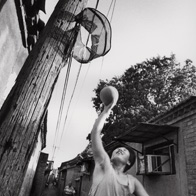 |
Americans see the triumph of the fist-pump, the irresistible force of freedom, as inevitable and maybe it is. Certainly, it worked for Yao and his team. In a gym filled with fans waving thousands of small red flags to commemorate China’s 54th National Day, the winners collect their trophy. And so, to a national streak that includes a booming economy, a successful Olympic bid, the wipeout of SARS and the launch of the country’s first spaceman, China adds its standing as the world's new hotbed of basketball talent. The Peoples Republic jams on.
SHENYANG
Nike’s Swoosh is more prevalent in China these days
than the red star, but aboard a train rolling south through the countryside
a week before the basketball championships, there can be no doubt where
you are. A peek out the window at the hills of Manchuria and the peasants
in straw hats leading donkey-drawn carts reveals the other side of the
world. Mao still graces the money. Millions of children still show up
at school wearing little red scarves. And there’s still only one
path to becoming a player in China: the system. For some, the system
starts in Shenyang, a drab northeastern province capital that had its
heyday 400 years ago. Now, little distinguishes it except the world’s
biggest steel factory and an enormous statue of the Chairman in the
central square. Shenyang has largely missed out on China's prosperity.
Time here has passed slowly. The local sports school is a case in point.
The relic from a long-ago era, when “Learn from the Soviets”
was a national motto, stands across a wide avenue from a Tire Town (spelled
out in English letters). It’s a conglomeration of gray, boxy apartment
blocks with cobalt-blue windows, smokestacks on both sides and large
Chinese characters on a fence out front that say, “Study Hard,
Practice Hard, Be Honest and Innovative.” Pole-vaulters, weightlifers
and table tennis players lend the facility the feel of a scale-version
Olympic village. If you’re from these parts and have a future
in basketball, this is your first stop. Days start at 5:30 a.m, with
exercise and running. Classes and practice go until dinner. Lights out
by 9. The routine is six days a week, 50 weeks a year. Each of the 140
students, some as young as 9, have been pretested to predict eventual
height. The dining hall is airy and unadorned except for a wall-mounted
TV that usually blares Japanese cartoons and two flanking posters of
Kobe Bryant (still popular, despite the stories the kids here have been
reading). Boys scoop rice from a huge iron bowl, then carry their tray
of eggs, lamb soup, cabbage salad and noodles to one of the crowded
round tables. “We have three maxims here,” coach Wang Ping
says. “Live together. Practice together. Study together.”
Coach Wang, a dark-haired man in his 40s with a lazy eye and a welcoming
smile, is the school’s dean. Perhaps to counteract any impression
that his players are harvested on hydroponic farms, he notes that the
coaches are also teachers and the curriculum includes Confucius. “First
you learn to be a man,” he says. “Then you play basketball.”
Nine- and 10-year-old men?
Wang concedes the transition can be difficult; for most boys, it’s
their first time away from home. But that’s how it’s done.
It’s a small sacrifice for a greater good. “They get used
to it,” he says. Song Yubo, a fuzzy-headed 10-year-old, comes
into the dining hall toting a Mickey Mouse backpack. “It was hard
at first,” he agrees. “I really missed my father and mother.
I even cried in my bed.” But now he sees his parents every Sunday
and isn’t at all unhappy. He feels special. “I’m going
to be a basketball star,” he whispers. At an afternoon practice,
Song and his mates play with heart. The gym echoes with their whoops
and cries as they race up court, dribble behind their backs, twirl the
ball on their fingers and sink foul shots, swish, swish, swish—the
ball drawn to the net like a magic trick. Coach Wang is admiring: These
little guys treasure their chance. If the pros only had their spirit,
China basketball would improve. So why hasn’t it? If they start
so young, why aren’t the Chinese yet among the best in the world?
Why does a Chinese player have to be seven feet tall to get noticed
by the NBA? Wang laughs. “That’s a big topic around here,”
he says. “We're not behind at age 10. It’s later. We’re
world leaders in table tennis, because quickness and agility are Asian
characteristics. But the yellow man doesn’t grow like the black
man.” A strange argument, considering the 7'5" Yao, but Coach
Wang isn’t talking just about height. Hes talking about the athleticism,
the speed, the hops. He’s talking genetics, DNA. You hear the
explanation all over China, from coaches, players and fans: a superior
quality of birth, or better genes, give the African-American the edge.
The tone isn’t altogether bitter. There is a fascination with
black culture—a hip-hop craze is currently sweeping the nation—not
to mention a hefty dose of national insecurity. As one Shanghai cab
driver summed up: “How can we compete? They play like they’re
disco dancing.” The level of awe can be comical. At the public
courts by the old People’s Stadium, William Nesmith, an American
from South Carolina who works here for a U.S. company that makes automotive
seats, sits down after competing on the losing side of a three-on-three.
William doesn’t scrape six feet, and at 44, he’s not as
quick as he used to be. But he’s probably the only black guy within
a thousand miles. Cautiously, a teenager approaches him. “NBA?”
the boy asks. Nesmith says the issue isn’t DNA. It’s game:
“Nobody’s holdin’ their man, no defense. Nobody’s
takin’ it to the hoop just kickin’ it out. Ain't no competitive
spirit.” Back at the sports school, practice has ended. It’s
already dark as the boys return to the dorm. Out front, a single bulb
lights a lone pay phone. Up on the fifth floor, you feel like you’re
on a submarine. In Song’s room, as in all the rooms, there is
no TV, no toys, just a pair of metal bunk beds and one of Song’s
roommates mopping the floor, his flip-flops leaving prints on the wet
tile. If there’s time before sleep, Song might borrow a GameBoy,
plop on his bed made up with Pikachu sheets and play Super Mario. Or
maybe he’ll do some homework. But mostly the kids sit around and
chat. Song and everyone else here—and nearly everyone in the system—is
an only child, the product of the government's zero-growth policy. Otherwise
brotherless, they now belong to a brotherhood, one bound by a half-court
heave of a dream. No matter who you ask, that dream is the same: play
in the U.S., play in the NBA. This desire, stoked by Yao’s success
and so many NBA broadcasts, may be the surest sign the monolithic system
is fraying. Song himself is sure he’ll be a point guard for the
Bulls. “I’ll buy a big beautiful house for my parents in
Chicago, then houses for my other relatives. Until then, Ill stay here.“
SHANGHAI
You can’t skirt the issue. As scouts scour the plains
of Mongolia for the next Yao, his success threatens to stereotype a
whole country as nothing but an untapped mine of giants. Then again,
with its 1.3 billion people making up 21% of the world's population,
you have to figure China has at least enough centers for every team
in the NBA. “It’s simple Darwinism,” says Terry Rhoads,
an American in his late 30s, at his office in Shanghai. The distance
between Shenyang and Shanghai is roughly the same as that from Boston
to Atlanta, but staring out Rhoad’s windows at this city’s
retrofuturistic Jetson spires, it’s another world. The tropical
sky—it is 15 degrees warmer here—is punctured by construction
cranes. The city’s dialect is virtually unintelligible to northerners.
Rhoads was a marketing director for Nike in China for eight years until
he started his own sports marketing company 12 months ago. He helped
arrange for Yao to play in Nike events in Paris in 1997 and Indianapolis
in 1998, in effect setting the stage for Yao’s NBA arrival. “The
true sign of a country’s basketball system isn’t its centers,”
Rhoads says. “It’s what they do with their forwards and
guards.” Don’t get him started on what the Chinese do with
their forwards and guards, not unless you want to hear about coaching
methods from the 50s and a phenomenal waste of talent.
On a warm, weekday, October afternoon, those outmoded methods are on
display at the Shanghai Technical Sports Institute. This is Yao’s
old stomping ground, but a dark shadow has draped the bucolic campus
since he left. Inside the gym, the ball clangs against the rim again
and again as the junior squad of the Shanghai Sharks trains; there’s
not a dunk in sight. The once all-powerful Sharks were 11-15 last season,
finishing 11th out of 14 teams. Worse, one fan gripes, “they’re
boring.” Under a Chinese flag that looms over the court, coach
Tang Tao grinds out serial cigarette butts on the hardwood. Stretching
the length of the court, an enormous banner reads: “Only those
who endure the suffering others cannot will know the happiness others
cannot.” The words have a particularly grim relevance for Sun
Xiaoyang, a 17-year-old on the junior team. Unlike most of his teammates,
who are tall but razor-thin, the 6'5", 190-pound small forward
actually looks like a player. But that wasn’t enough to get him
on the starting five last season, or on the court much at all for that
matter. By all accounts, his game has stalled since he’s been
here. By the looks of things, Sun hasn’t turned it around. He’s
stripped of the ball, has a pass stolen, runs listlessly up the court.
“He has love for the game, but it’s not enough,” Coach
Tang says. “With his body, he should be on the pro team. But his
skills are weak. He lacks basketball consciousness. Why pass now? Why
stand there? He must play harder. Maybe he has to suffer more than others.
If he doesn’t, hell never make it.” There is plenty of opportunity
to suffer on this court. Tang calls a drill in which the players take
a charge. One after another, the boys face their man under the basket,
set their feet then get shouldered in the chest by the ballhandler and
sent sprawling. The Sharks can’t shoot, but they can take a hit.
This might be what Rhoads was talking about when he said, “It’s
heartbreaking. You’ve got diamonds in the rough, and they get
sanded away until nothing is left.”
In China, the traditional route into basketball is hereditary; children
of players become players. But Sun's parents aren’t players. They’re
not even tall. If you ask his mother, Ye Dong Hong, she’d just
as soon her boy became a professor. But she and her husband, a driver
for a local company, are support-him-whatever-he-does types. Only once
did Sun’s college-educated parents intervene—his first year
of middle school, when his grades dipped. “We gave him an ultimatum:
work on your studies or choose basketball as a career,” Ye Dong
Hong says. Sun chose basketball. He was 13. “The first toy my
father bought me was a small basketball,” Sun says. “From
that first moment I was addicted. I couldn’t live without it.”
He pauses. “I made a decision on an impulse.” And if it
doesn't work out? Sun won't think about that. The system might be fraying,
but the tradition of perseverance is intact. “I chose this path,”
he says. “I have a responsibility to pursue it to a good end.”
GUANGZHOU
On the oily, green-gray Pearl River, boats slide past
the Guangdong Sports Institute on Ershadao Island. This is the south
of China, much closer to the jungles of Vietnam than to the bustle of
Beijing. By 9 o’clock on this late-September morning you’re
already drenched in sweat. Fitting, because for Chinese basketball players,
this is the hot zone. And that too makes sense, because Guangzhou, a
thriving megacity (pop. 6.6 million) near Hong Kong, is the traditional
beachhead of foreign influence in China. Currently, it is home to the
country’s best pro team and latest basketball dynasty-in-the-making,
the Guangdong Tigers. At a plastic table on the wharf, Chen Jianghua’s
leg bounces under the table like he might just blast off. Chen is the
one-in-a-billion find, the wonder kid of China. He led the Tigers junior
squad to an undefeated season this past spring, and is a member of the
2008 Olympic hopeful team. At 15 and only 6'2", he is already being
discussed as an NBA prospect, possibly the first Asian point guard to
make the jump. “I’m different from the others,” Chen
says. “I play a different style. I attack with inspiration.”
He admits to picking up some of that style from those NBA telecasts,
more from his two trips to America. Clearly, something Western has rubbed
off. In a photo of his first trip, to a Nike tournament in Portland
in March 2002, he smiles from beneath a buzz cut. Now his hair is a
devilish porcupine shag. He wears baggy jean shorts that say Snoop Dogg
up the leg and the latest sneakers sent to him by Rhoad’s company.
“The kid oozes attitude,” Rhoads says. “He’s
got the mojo.” But even here, what is cultivated aren’t
spins or dunks or the fist-pumping aggression of those who have the
mojo. Coaches at the Institute instill the European style, an egalitarian
effort. The style informs the officiating as well. When Chen spins down
the lane and draws contact, more often than not the calls will go against
him. It’s as if fouls are called to weed out suspect attitudes.
“They say my play is too exaggerated,” Chen says. “I
want to attack, one-on-one, one-on-two. I understand the coach wants
me to improve my weak points, but I want to show my advantages.”
For now, Chen’s willingness to express himself, with the ball
and without it, sets him apart. By 14, it had already earned him a reputation
as a malcontent. Staring out over the water toward the Institute where
he lives, Chen says, “We put a lot of attention on teamwork, but
not on personal progress. Maybe I’d have a better chance training
in the U.S.” That’s not going to happen. The Chinese Basketball
Association recently refused to let 21-year-old Xue Yuyang, a 7'1",
235-pound center for Hong Kong’s Flying Dragons, play in the States
after he was drafted by Dallas and traded to Denver, citing a lack of
experience. In truth, ever since Wang Zhizhi, the first Chinese player
in the NBA, decided to stay in the U.S. in the summer of 2002 rather
than return home to train with the national team, the rules have changed.
Now, Chen says, you’re lucky to get one or two months in the U.S.
Chen’s family lives in an apartment in Panyu, a city 30 miles
south of Guangzhou, but they are not city people. The Chen’s are
from Shenzhen, and from the eel-fishing boats on the South China Sea.
“I’m not well-educated, all I can do is fish,” says
his mother, Huang Huanjin. “I didn’t lead such a good life.
So seeing my son become famous, I am happy.” A short woman in
a floral shirt with sun-baked skin, Chen’s mother says she had
no idea her son would become an athlete. “He was so short, so
thin,” she says, “I was afraid he wouldn’t make it,
that he wouldn’t get a chance to play.” But she’s
come around. She recalls watching Chen compete in Shenzhen last season.
“When he went into the game,” she says, it changed. “He
showed his beautiful moves. The game became exciting.” Still,
her ambitions for her son remain simple: “If he can show his potential,
no matter where, I’ll be happy. If he can’t play basketball,
he can always help us with the fish.”
Of course, the hooks and nets that interest Chen won't snare eels. When
Chen visits home over the National Day vacation, he joins in a friendly
game of four-on-four on the concrete courts at Panyu Middle School where
he once played. He’s in an awkward spot. The last thing he wants
to do is show off in front of peers he left behind. Then again, who
wants to lose? He tries nothing fancy, no flying moves to the rim, no
ankle-breaking crossovers. Instead, he sticks to long jump shots. He
flings one from outside, misses. He misses another from 15 feet. A third
misses too. It’s like he’s doing it on purpose. But the
fourth is a thing of beauty, a shot flicked quickly from deep behind
the three-point line, a shot with virtually no arc that slashes through
the net. And in that single instant you see the thoroughbred in him
unleashed, all the minute movements coming together, the feet, the hands,
the eye, the wrist. Like Yao’s fist-pump, the shot is an assertion
that can no longer be held down. It is a declaration of independence.
It says China is ready for the next great leap forward.

BRANDON ROY - Playmaker of the Year
JOBA CHAMBERLAIN - Rocket Redux
NOEL DEVINE - Time for Some Devine Justice
PATRICK WILLIS - Butkus, Done Bay Area-Style
TYSON GAY - Hail the Reigning King of Speed