BABY YOU’RE THE GREATEST
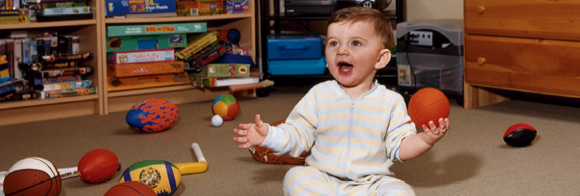
Want to Know What Sport Your Kid Should Play? Why Wait? Everybody into the Gene Pool!
By Tom Farrey
It’s noontime in smalltown Connecticut as Kellen,
my 1-year-old, awakens from his nap. The shades are drawn, the room
dark, the air purifier on a low hum, as I slowly push open the door.
He’s sitting up in his crib, one hand holding his favorite blue
blanket, the other rubbing blue eyes that blink back the hall light.
Next to him is the music-box pillow that had sung him to sleep, to the
ting-ting-ting of “Here Comes Peter Cottontail.”
“Hi, kicker boy,” I say, using his nickname du jour, so
given because of his diaper-time obsession with whacking his heels on
the changing table as rapidly as possible, like a Benihana chef with
new knives. Kellen, of course, does not get my reference, as he does
not yet talk, or walk.
But he does drool. And it’s a sample of that saliva that I’m
looking to harvest right now—because his wipe-away spit, clear
as a crystal ball, offers genetic insight into his future as an athlete.
As Kellen squints back up at me, I slide the end of a Q-tip into the
side of his mouth, rub it around the gum area for 20 seconds and drop
it into a “Sample Transportation Bag” with his name scrawled
in pen on the outside.
In two hours, my flight leaves for Australia. “All right, kicker
boy,” I say, sealing the baggie. “Let’s go find your
destiny.”
The Founding fathers declared that all men are created equal, a bedrock
principle that has been extended to define the ethic of American sports.
Despite evidence to the contrary—notably all the kids of retired
pros who are now pros themselves—we still pledge allegiance to
the notion that hard work separates the great from the ordinary. That
Tom Brady just wanted it more. That Serena simply fought her way to
glory. That Ichiro hustled up the single-season hits chart.
The Aussies, blunt about everything, are more willing to explore the
role that inherited traits play in athletic achievement. “I think
anyone who opens their eyes will realize that certain people have talent
for activity A, whereas others have talent for activity B,” says
Deon Venter, chief pathologist at Genetic Technologies in Melbourne.
The doctor, a former Ironman champion, is sitting on a raised swivel
chair inside the company’s quiet lab, where DNA samples are being
processed. A robotic machine on the counter behind him extracts samples,
including Kellen’s, and drops them into rows of vials.
In December, at Venter’s urging, Genetic Technologies began selling
what it calls the world’s first DNA test for sports performance.
Available over the Internet to anyone with a mouth swab and 110 Australian
dollars ($85 U.S.), the test evaluates just one gene, ACTN3, whose relevance
was discovered more than a year ago by a University of Sydney researcher.
When there is no mutation, the gene creates the protein alpha-actinin-3,
which fuels the explosive machinery in fast-twitch muscle fiber.
Every human being gets two copies of every gene (one from Mom, one from
Dad). So for ACTN3, the genetic lottery determines whether a child gets
two, one or zero copies of the form linked to fast-twitch fibers. Not
surprisingly, when testing the genotypes of 429 of Australia’s
top athletes in 14 sports, including 50 Olympians, researchers found
that participants in sprint and power events were far more likely than
average Australians to have two copies. In effect, they were getting
a double shot of fast-twitch espresso. By contrast, athletes in endurance
sports were more likely to have no copies, suggesting that an advantage
in those events is gained when the muscles must rely on slow-twitch
fiber.
“Sports performance is a jigsaw puzzle, and this is just piece
No. 1,” Venter warns. But as we stare at a monitor that gradually
displays Kellen’s results, which are being decoded in a gene machine
about the size of a microwave oven, I am filled with anticipation and
queasiness. How bizarre will it be to know if he’s cut out for
sprinting while he still can only crawl? As a parent, even one whose
instinct is to expose my kids to the diversity of life and let them
find their own way, can I be trusted with such information?
A lab tech copies the results onto a CD, converts them to a graphically
pleasing format and hands the disc to Venter, who pulls up a series
of bar charts on his laptop. “Well, Tom, here are the results,”
he says in a gentle voice. The vertical bars on Kellen’s graph
are absent. In ACTN3 terms, hes a zero (like 20% of the population).
“This is more likely to fit with an endurance athlete,”
Venter confirms.
“So we’ll skip the 100-meter dash,” I say.
“He can do it if he wants to do it,” the doctor replies,
“but statistically speaking, based on what we know now, he’s
less likely to do well because he will not apparently make sufficient
power.”
Venter is a geneticist, not a sports physiologist, so I’ll save
the question of which activities would be best tailored to Kellen for
tomorrow. That’s when I meet with the experts at the Australian
Institute of Sport, which made its elite athletes available for DNA
analysis in the landmark ACTN3 study. But I’m curious to know
if Venter, an accomplished endurance athlete himself who happens to
have the same ACTN3 architecture as Kellen, thinks my baby boy has the
stuff of an Ironman.
“He might, if he can stand the pain,” Venter says. “That’s
something we don’t know how to measure yet.”
Yet. It’s the geneticists favorite word.
The ancient Greeks attributed many human acts to the whims of mythical
gods and goddesses. Dionysus made folks get drunk. Aphrodite made the
furniture move. Nike made victory (and still does, at least some of
the time). Modern science has unlocked many secrets. But even now that
we know the instructions for life can be found in the 30,000 or so genes
that make up the human genome, were still a bit like those old Greeks,
guessing at the source of powerful forces.
For years, people simply assumed that Eero Maentyranta, the great Finnish
cross-country skier, was doping when he won two golds at the 1964 Olympics.
After all, others trained much harder. Only later was he discovered
to be a genetic freak, the beneficiary of a mutation that allowed his
body to produce 50% more red blood cells than normal. Those cells carried
extra oxygen to his muscles. It’s the same advantage drug cheats
try to get by taking EPO.
So far, researchers around the world have associated 124 genes with
physical activity. But the emphasis of many studies has been on fitness,
not performance. Scientists expect to find that a lot of athletic traits,
such as hand-eye coordination, involve a cluster of genes. Even the
ACTN3 test, which included only white subjects and focused on muscle
type, has its detractors. “If you want to find out which kids
have fast-twitch fiber, just line them up and fire a gun in the air,”
says Steve Fleck, a former U.S. Olympic Committee scientist who now
works with Sports Potential, a Bay Area start-up that helps kids and
adults find their ideal sport. “You’ll see which ones run
fast.”
Still, as more elite athletes get tested, the genetic database will
grow, revealing patterns and allowing for predictions with greater accuracy,
based on statistics. Ultimately, it’s possible that when a boy
like Kellen is born, the vial of blood taken to genetically screen for
diseases could also be used to spot athletic traits. Plug the results
into the Theo Epstein All-Athlete Database, and before leaving the hospital
the baby’s parents could get a report on which stars best match
his DNA—quite the head start if they hope to create the next Freddy
Adu or Matt Leinart.
Some of the most cutting-edge research is being done at the Australian
Institute of Sport, a three-hour drive north of Melbourne, in the capital
city of Canberra. The AIS gets $40 million a year from the government
to identify and develop potential stars, many of whom live and train
at the 160-acre facility. Its as much a sports factory as anything East
Germany ever sponsored, minus the institutional doping and coercion.
Inside his office, the director of the sports science unit taps his
fingers nervously on a table. With his thin face, modest eyewear and
measured demeanor, Peter Fricker looks nothing like a mad scientist.
“Is this for the AIS to do?” he wonders. “Open the
lid on Pandora's box?” He knows that by making his athletes available
for DNA analysis, he’s helping move sports in a new and uncertain
direction. Concerned that such knowledge could lead to gene doping,
the Australian government temporarily suspended genetic testing by the
AIS in 2003.
But the country can’t afford to stand idly by: athletes in England,
Mexico, China and elsewhere are being tested, and the Aussies role as
the leader in sports science is at stake. With the AIS feeding its pipeline,
the nation won more medals per capita in Athens than any other except
the Bahamas (the U.S. was 39th by that measure). So Fricker expects
to receive the green light on gene work from the minister for sport
in the coming months, provided the AIS adheres to an ethical code he
hopes the rest of the world's athletic bodies will adopt. There can
be no AIS testing of kids under the age of 12, for instance. And its
researchers must work hard to understand the value of each genetic marker,
so coaches don’t just cut a player for atypical DNA. (After all,
Lleyton Hewitt was supposedly too short for tennis.)
Some cold decisions are inevitable, though. I can hear the echo of Charles
Darwin in the chipper voice of AIS exercise physiologist David Martin,
an American who left the U.S. Olympic training center a decade ago because
of the Aussies embrace of sports science. We meet on campus at the biomechanics
dome. In the background, on a red rubber track, a doctoral student obediently
holds a stick upright for a bearded, slightly obsessive-looking technician
tapping furiously on a laptop, calibrating a camera that analyzes a
runners stride. Clearly, the geeks run the show here.
“There’s only so much taxpayer money,” Martin says.
“If three or four athletes are performing at similar levels, the
coach could use the genetic test to persuade himself to go with one
athlete instead of another, to increase the likelihood of success.”
My mind drifts to Kellen and what we know of his evolutionary stew.
His maternal grandmother, who played college tennis, marvels at how
well he whacks a rolling ball with either hand. Starts low. Finishes
high. Topspin deep into the corners?
“With tennis,” Martin says, “you want to have fast-twitch
fibers to move dynamically.”
“What about basketball?” I ask.
“Same thing.”
“Baseball?”
“I’d be going for fast-twitch.”
“Football?” At least Kellen has the right name. But I anticipate
the doctor’s answer.
“The most explosive guys on the planet.”
Martin is now chuckling sympathetically.
“Good hand-eye coordination and endurance,” he says, mulling
the optimal sport for Kellen. “How about biathlon? They ski for
long distances and shoot a rifle”.
And so it shall be. Meet the next Ole Einar Bjoerndalen.
ALL KIDDING aside, I have something of a dilemma now, right? It’s
not as if we in the U.S. have the smartest sports system in the world.
Most kids get funneled into the same four or five mainstream games,
not because their bodies and minds are tailored for success, but because
those are what Mom and Dad played. More than 70% of them quit sports
by age 13, usually because they can no longer make the team or they’re
not having fun. Now Couch Potato Nation has an obesity epidemic. Maybe
biathlon isn’t the answer for Kellen, but a more thoughtful approach
to sports selection has its benefits.
I can see those rewards in the blue eyes of Emma Lincoln-Smith. In December,
I found the blond, sturdy, 19-year-old near the top of a snowy mountain
in Park City, Utah, half a world away from the golden beaches of Narrabeen,
Australia, where she practically grew up on a surfboard. Until the previous
month, she’d never heard of the sport of skeleton, in which competitors
sled headfirst down a twisting chute at speeds reaching 80 mph, their
chins mere inches above the ice. The AIS, which gives physical tests
to teenagers all over the country, liked her 30-meter sprint power on
dry land, so they invited her to join a new national skeleton team.
Now she was representing Australia at an America's Cup race as her nation’s
top sledder.
As we talked after the race (she finished eighth), Emma winced while
holding ice packs on her left hip and knee, deeply bruised from a crash
on Turn 12. Her coach figures she’s good enough to win an Olympic
medal someday, if she can learn how to steer. “I feel like this
has been coming all my life, that fate brought me here,” she says.
“I love going fast. I love dangerous sports. So when the opportunity
came up, I just had to take it. It’s the best thing that’s
ever happened in my life.”
Genetic screening is the logical extension of Talent Identification,
or TI as the Australians call it. Venter, for one, says his ACTN3 test,
which hits the U.S. market this spring, is intended to help kids and
adults find lifelong avenues of exercise, not to further professionalize
youth sports. “We don’t see how a genetic test is going
to put any more pressure on children than has already been applied by
parents for generations,” he says. “In fact, it might help
stop a father from pushing his child to do well in a sport he wishes
he had done well in, but for which the child is not genetically suited.”
Venter advises me not to act on what little we know about Kellen’s
genes until after he’s had time to climb trees, experiment with
a few sports and define his interests on his own. I agree. It’s
his life, not mine. But I’m glad I have the information. That’s
all it is, data, not Dolly the sheep. I trust that I will know when
the time is right, if ever, to use it as a resource. If Kellen picks
a power-based sport, we can always tailor his training. Destinies are
surely as much made as found.
Still, after returning from Australia, I couldn’t resist one last
experiment in ridiculously early TI. I had learned that elite soccer
players have unusually long ring fingers (compared to their index fingers)
on their left hands. It’s apparently a marker of prenatal testosterone,
which helps form a strong cardiovascular system. So, in the interest
of science, I sent a photocopy of my kids paw to John Manning, the English
pioneer of this quirky research. On the morning of Kellen’s first
birthday, I reach Manning in his office at the University of Central
Lancashire. He greets me with an amused laugh. “I’ve not
looked at many hands of people so young,” he says.
But digit length is fixed for life, so I want to know: can Kellen’s
fingers point us in a direction? Manning sets the phone down, to measure
with his calipers. There is silence for half a minute, as he does the
math, then does the math again. Kellen’s left index finger is
30.75 millimeters long; his ring finger is 34 millimeters. “So
if you divide those two, his ratio is .90,” Manning says. “That
is very low, the kind of ratio that one sees in international-level
soccer players.”
Now that’s more like it. Kicker boy wakes from his nap in about
20 minutes.

BRANDON ROY - Playmaker of the Year
JOBA CHAMBERLAIN - Rocket Redux
NOEL DEVINE - Time for Some Devine Justice
PATRICK WILLIS - Butkus, Done Bay Area-Style
TYSON GAY - Hail the Reigning King of Speed