NEXT: ENGINEERED ATHELETE
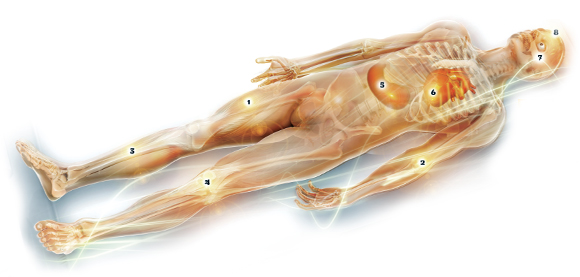
Thanks to the miracles of science, the jock of the future will
see better, heal faster, and feel less pain than his or her predecessor.
Here’s how.
By John Helyar
WIRED MUSCLES
Using electricity to zap muscle pain has been a practice for decades,
but more and more pro athletes are turning to a newer form of the treatment,
Frequency Specific Microcurrent, to hasten healing. Traditional electrotherapy
methods block pain in part by zapping nerves around the wounded area,
but FSM actually speeds the body’s healing capacity by mimicking
the electrical currents that occur naturally in human cells. Terrell
Owens (ankle), Donovan McNabb (chest) and Tracy McGrady (back) have
all used it to recover more quickly.
SAFER HEARTS
The presence of AEDs (automated external defibrillators) on high school
sidelines continues to grow. Following the deaths of four prep athletes
from sudden cardiac arrest in 2006, Texas has joined Illinois, Maryland
and New York in requiring all public schools to have the device on their
premises. Even states without such laws are seeing a jump in the number
of AEDs available to young athletes: More than half of Washington’s
schools now provide defibrillators.
SHARPER EYES
Several D1 baseball teams and a couple of MLB clubs are trying new optical
training programs to improve the visual skills of players. One such
method, Vizual Edge (used by Tennessee, Georgia Tech, the Reds and the
Royals, among others), has athletes don 3-D glasses, then click through
a series of visual agility exercises to improve their ability to shift
focal points and track small objects (like spotting a curve versus a
fastball). Vizual Edge is also catching on with some NFL draft hopefuls
prepping for the combine.
JELLY BELLIES
In a study last year of 16 competitive cyclists and triathletes, researchers
at UC Davis found that the specially designed Sport Beans from Jelly
Belly Candy Co. were effective at replenishing electrolytes and vitamins.
During four 10K time trials, the candy’s impact on athletic performance
equaled the benefits of sports drinks and gels; scarfing beans and water
was also much better than just chugging alone. Oh, and candy tastes
good.
PAIN FREE ELBOWS
According to researchers at Stanford, there’s a new surgical alternative
for tendinitis: your own blood. In the November issue of The American
Journal of Sports Medicine, scientists report that by drawing blood
from a healthy part of the body, processing it to boost platelet content
and injecting it into the blood-poor region of the affected elbow, doctors
can kick-start healing. The result: a 93% success rate, equal to that
of surgery but without the knives.
BIONIC BONES
To help badly broken bones heal more quickly, sports orthopedists and
prominent surgeons such as Dr. James Andrews are turning to a new bone-grafting
method called Infuse. Approved by the FDA for use in the tibia and spine,
the process uses a naturally occurring bone-building protein called
BMP that has been genetically engineered in large quantities. Its new
form, rhBMP, is soaked into a bovine-collagen sponge and applied as
a graft to the broken bone. The process triggers much faster healing
than a conventional bone graft.
SILKY KNEES
Silk is one of the strongest natural fibers on earth, and it may also
be the best way to repair a blown ACL. Boston biotech firm Serica, building
on research by Tufts University, has developed a procedure in which
a ruptured ACL is rebuilt with a scaffolding of biodegradable silk.
Serica says the surgery results in a stronger ligament than one repaired
via traditional means (repurposing tendons from the patients body).
The goal: to reduce recovery time from six to three months. Human clinical
trials begin this year.
RESTED MINDS
Turns out Lance Armstrong really did have a competitive advantage: it’s
called napping. A researcher at the Salk Institute has shown that reaching
stage two (restful, not deep) sleep for 20 minutes each day reinforces
the connections between the brains neurons that control muscle memory
and aid mental and visual acuity. This, in turn, boosts performance.
As Golden State guard Jason Richardson said recently, “If I don’t
nap, I’ll have a horrible game.”

BRANDON ROY - Playmaker of the Year
JOBA CHAMBERLAIN - Rocket Redux
NOEL DEVINE - Time for Some Devine Justice
PATRICK WILLIS - Butkus, Done Bay Area-Style
TYSON GAY - Hail the Reigning King of Speed